

(800) 337-4002
call for your free personal
injury case consultation
Available 24/7
injury case consultation
Available 24/7

It is easy to think of negligence in accidents as black and white or all or nothing. One driver’s negligence caused the accident, and another innocent driver was harmed. But that is not really how the legal concept of negligence works, especially in the state of Kentucky. We are under a pure comparative negligence system, which allows people injured in an accident to still seek compensation, even if they are partially at fault.
If you were injured in a shared fault accident, speaking with a Lexington personal injury attorney from Gary C. Johnson P.S.C. can help answer your questions and work towards getting the compensation you are owed.
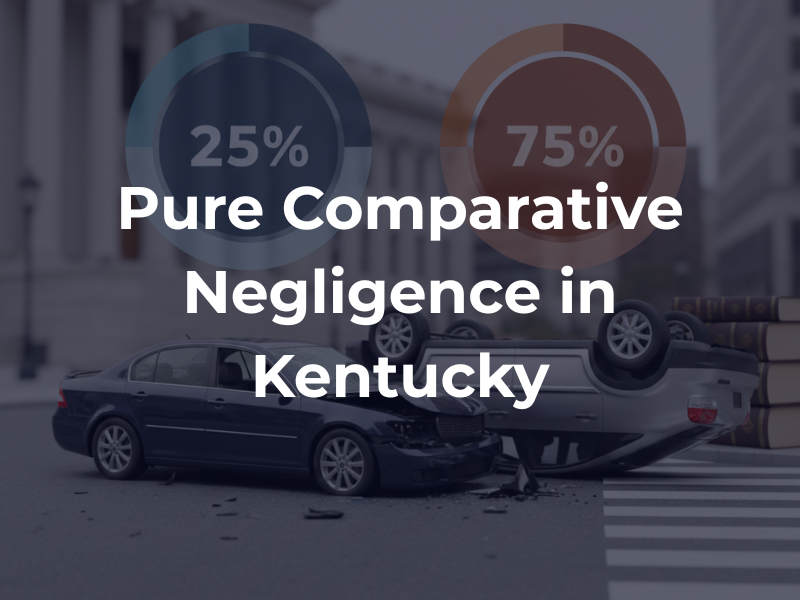
Kentucky’s pure comparative negligence system allows you to recover compensation even if you share in the fault of your accident. Unlike states with a modified comparative negligence system that bars you from recovery if you are over 50% at fault, there is no limit to the amount of fault that you can have in Kentucky.
Under Kentucky Revised Statutes (KRS) § 411.182, an accident victim may recover damages even if they are found to be 99% at fault for the incident. This rule ensures that everyone is held responsible for the amount of damages that they caused and prevents a defendant from escaping liability just because the plaintiff made a mistake.
While you can still recover compensation if you are found to be partially at fault for your accident, your total award is directly impacted by that percentage of fault. In a personal injury case, a jury will be tasked with assigning a specific percentage of fault to every individual or party involved. Then they will calculate the total amount of your losses and subtract the percentage of fault from that amount.
For example, your lawyer may have calculated that your comprehensive losses are $200,000 for past and future medical bills and lost pay. If you are deemed 25% at fault for your accident, your total award will be reduced by $50,000 for a total recovery payout of $150,000.
This makes the strategic evidence presented by your lawyer even more important, since the defendant will know that the more they emphasize your negligence, the less they will have to pay. Working with an experienced lawyer can help ensure that the fault is fairly allocated among all parties involved.
Because negligence is such an important part of your case, you will need to focus on proving that negligence directly caused the accident. If your taillight was out when the accident occurred, the other party may emphasize this as negligence on your part. But if the accident occurred during the day, you may be able to prove that this had no part in the actual cause of the accident.
Conversely, you must work to prove that the defendant’s negligence, such as speeding or distracted driving, was the primary cause of your accident. Because every percentage point of fault assigned to a plaintiff results in less money for their recovery, insurance companies and defendants will aggressively attempt to maximize the victim’s perceived liability.
In comparative negligence cases, liability is a numbers game. The more fault assigned to you, the less the defendant pays. Insurance companies know this and structure their defense around minimizing their exposure.
An experienced Kentucky personal injury lawyer can:
If fault is disputed in your accident, legal guidance can make the difference between a reduced payout and fair compensation.